
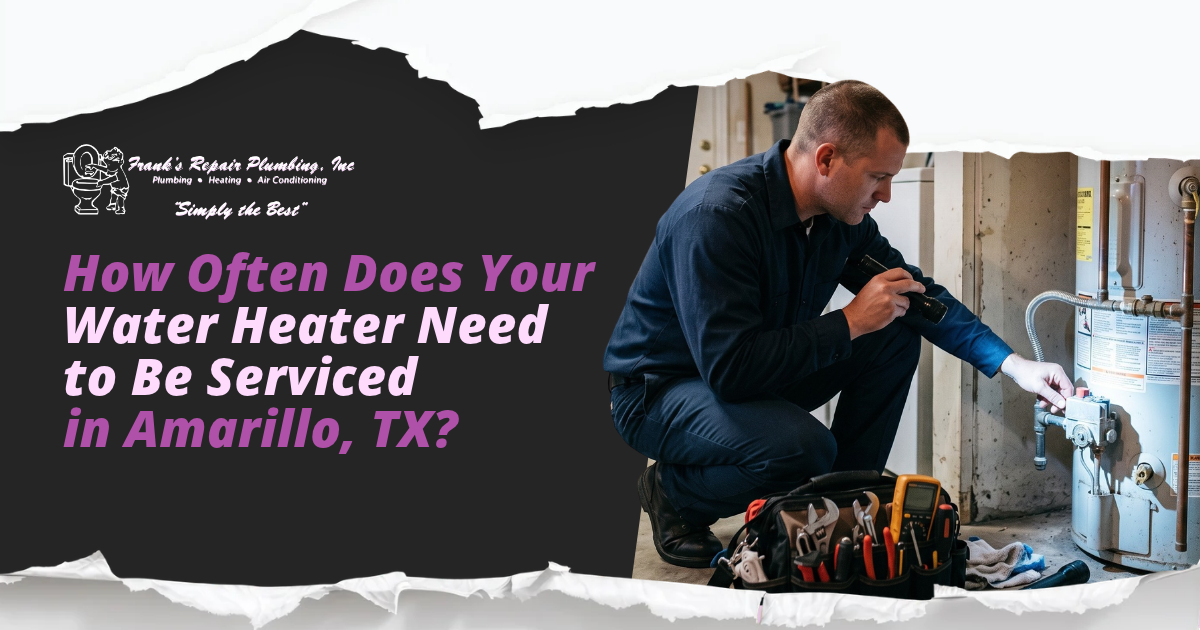
Following a regular water heater maintenance schedule protects your equipment and reduces the risk of sudden breakdowns or system failures. How often to service water heaters, however, can vary based on a few factors, including the unit type and how Amarillo’s hard water affects your system.
Service Schedule by Water Heater Type
How often should a water heater be serviced depends on the system type, with different maintenance tasks and intervals for tank and tankless units.
Conventional storage tank water heater
Conventional storage tank water heaters need:
- Visual inspection: Perform a visual inspection once per month.
- Flush the tank: Every three to six months, flush the tank to clear out mineral and sediment buildup.
- Professional inspection: Schedule a professional service annually to test the T&P valve, check for leaks, clean the burner assembly, and inspect and adjust other components as needed.
- Anode rod check: Sacrificial anode rods attract corrosive minerals to protect the tank’s inner lining. A professional can check the anode rod and replace it as needed, usually between one and three years.
Tankless water heater
Tankless water heaters have similar service intervals compared to conventional units, but they require different services:
- Cleaning the inlet water filter: Every three to six months, clean mineral buildup from the cold water inlet filter.
- Descaling the heat exchanger: Heating components require descaling once or twice per year.
- Professional inspection: Schedule tankless water heater services annually. Professionals inspect, clean, and adjust heating components and controls as needed to ensure safe and efficient performance.
How Amarillo’s Hard Water Affects Water Heaters
At about 248mg/L ppm, the water from the Ogallala Aquifer in the Texas Panhandle contains dense concentrations of calcium and magnesium that rapidly crystallize when exposed to the high temperatures of your water heater. Here’s how Amarillo’s hard water affects water heaters:
- Sediment buildup: Minerals form dense layers of sediment at the bottom of the water heater tank and gradually harden over numerous cycles, which insulates the burners or elements beneath and causes water to boil and damage the tank floor.
- Anode rod depletion: Hard water causes anode rods in Amarillo to wear out in two to three years, compared to the three to five years in areas with balanced water quality.
- Equipment lifespan: Without timely maintenance, thermal stress, sediment buildup, scaling, and other strain and wear shorten the operating life of your water heater in Amarillo, sometimes to as few as six years.
- Efficiency loss: Sediment in water heater tanks or scaling on tankless heat exchangers act as insulators. This limits heat transfer and forces the system to work harder or longer to reach target temperatures, resulting in significant efficiency losses and higher energy bills.
How Often Do You Flush a Water Heater?
Most units require flushing every six months or annually, but how often you should flush a water heater depends on certain factors:
- Water hardness
- Household usage
- Manufacturer and warranty requirements
- Unit age
Water heaters in Amarillo may need more frequent flushing to counteract the effects of very hard water (about three to six months). If your home has a water softening system, you may be able to wait longer between servicing.
How to Flush a Tank Water Heater
To flush a tank water heater, make sure that you’re familiar with the drains and valves and confident in handling the task. Follow these steps on how to flush a tank water heater.
Shut off the power
For gas water heaters, turn the gas line’s supply valve off. If you have an electric water heater, turn off the power at the circuit breaker. Set the water heater’s thermostat to off or vacation mode.
Turn off the water supply
Turn off the water at the valve connected to the main supply line or at the main water meter. Wait for the water to cool off before the next step (at least 30 minutes). Open a hot water faucet at a fixture in your home to prevent a vacuum effect while the tank drains.
Drain the tank
Attach a garden hose to the spigot at the bottom of the tank, and place the other end into a floor drain, outside, or into a bucket. Turn the drain valve to open it, and let the tank drain completely.
Flush the sediment
When hot water no longer flows from the hose, turn the water supply back on at the tank. Let the tank fill with cold water to disturb the remaining sediment, then drain the tank again. Repeat this step until the water from the hose runs clear.
Refill the tank
With the water supply valve shut off, remove the hose and close the drain valve. Then, turn the water supply back on to refill the tank. Close any hot water faucets still open.
Restore power
Turn the gas valve or circuit breaker back on, and turn on the thermostat to 120°F. The tank should replenish after one to two hours.
When to Call a Plumber for a Water Heater Service
Some maintenance tasks are doable for DIY-inclined homeowners, but other problems should be left to professionals. Call a plumber for water heater service if you encounter these problems:
- Active leaks or pooling water: Leaks from fittings or connections may need adjustments or replacement valves, while water pooling around the base suggests that the tank has cracked.
- Scalding water: A faulty thermostat or broken T&P valve may cause water from your faucets to become dangerously hot.
- Cold water: If your hot water runs out and doesn’t replenish, contact a plumber to check for failed heating elements, heavy sediment buildup, or other underlying problems.
- Stuck or damaged valves: Avoid trying to force stuck or damaged valves open, which can result in complete valve failure and significant flooding.
- Visible corrosion: A water heater storage tank with visible corrosion may be failing and due for a replacement.
- Aging unit: Storage tank water heaters last about 10 years, after which they’re at higher risk for sudden leaks or breakdown.
- Persistent noise: If your rumbling, popping, or banging sounds continue from your water heater even after flushing, a plumber can inspect further for sediment buildup.
- Gas hazards: Rotten egg-like odors, carbon monoxide alarms, and other signs of gas hazards are immediate and serious hazards that require emergency services and urgent professional attention.
- Electrical issues: Call a plumber if your water heater repeatedly trips the breaker or you notice sparks, scorch marks, and other signs of electrical issues.
What Does a Water Heater Service Include?
Depending on the unit type, a water heater service includes:
- Sediment and debris flushing
- T&P valve check
- Leak inspection
- Gas line and valve inspection
- Burner, flue pipe, and vent check
- Emergency cut-off test
Signs Your Water Heater Is Overdue for Service
Call Frank’s Repair Plumbing if you notice these signs that your water heater is overdue for service:
- Rumbling or popping noises
- Rusty or discolored water
- Inconsistent water temperatures
- High energy bills
- Flickering pilot light
- Slow recovery
Schedule Water Heater Service With Frank’s Repair Plumbing
Choose Frank’s Repair Plumbing for water heater services, whether routine maintenance, emergency repairs, or new system installations. Contact us today to book your water heater services.