

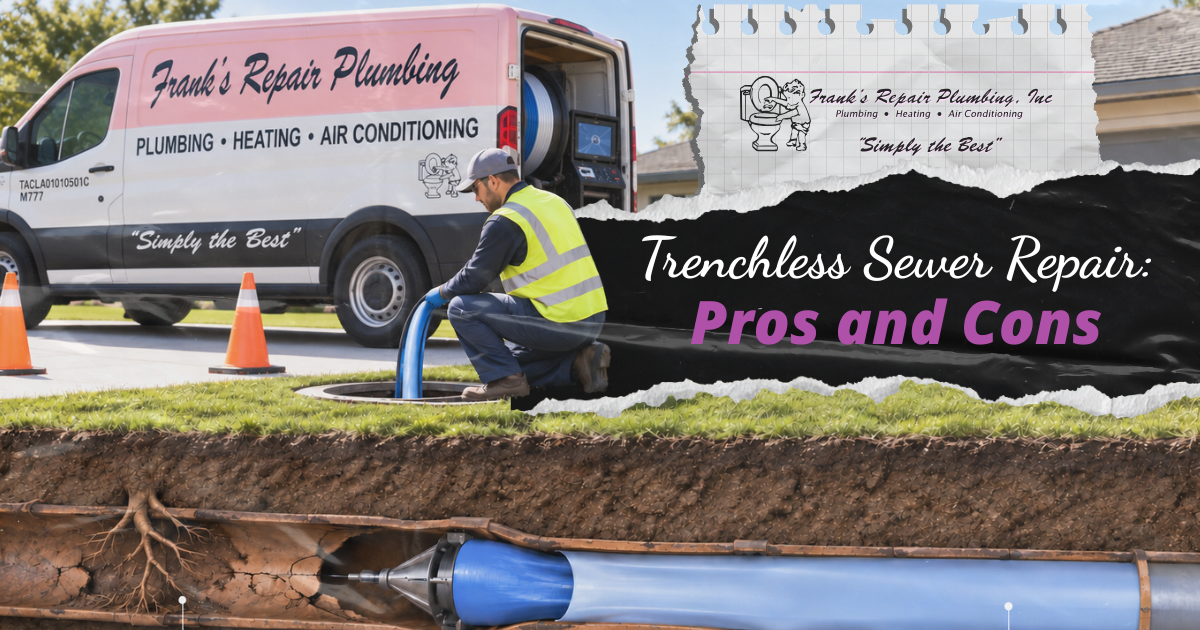
If you have a sewer line that needs repair, there are two ways to handle it. One is to dig a trench through your yard or floor, and the other is to repair or replace the buried sewer pipe through a couple of small access holes, minimizing the damage to your property. For most homes, the most reliable no-dig option is pipe bursting, which replaces the damaged line with a brand-new pipe instead of patching the old one.
Signs that you have a collapsed or broken line include slow drains, sinkholes, foundation cracks, sewage odors, and increased pest activity around your home. Here, we’ll look at the cost differences between digging and trenchless options, the pros and cons of no-dig pipe repair work, and why pipe bursting can be a better trenchless solution than lining the existing pipe with cured-in-place pipe (CIPP).
What Is No-Dig (Trenchless) Sewer Repair?
In Texas, many homes are built on concrete slab foundations because they’re a practical, less expensive alternative to basements and crawl spaces. The foundation also needs to account for the expansive clay soil here which swells when it’s wet and shrinks when it dries. Lines often run beneath the house, which means that fixing a broken sewer line under the slab traditionally means digging or cutting through the floor, or tunnelling under the house from outside.
No-dig (trenchless) sewer repair fixes the pipe running under your home, or underground from your house to the street, by working through two small holes, one at each end of the affected length of pipe. Two common methods are CIPP and pipe bursting.
CIPP lines the existing pipe with a resin-soaked liner that hardens in place, but it comes with a number of drawbacks:
- It depends on the old pipe: The liner follows existing sags and offsets, and badly damaged lines often can’t be lined at all.
- It makes the pipe smaller: The liner reduces the inside diameter and can’t upsize the line.
- Results are harder to control: Wrinkles, incomplete curing, and poor bonding can leave weak spots that catch debris.
Alternatively, pipe bursting avoids these problems by replacing the old line entirely. A cone-shaped bursting head is pulled through the existing sewer line, breaking it apart while pulling a new pipe into place behind it. The new line is typically high-density polyethylene (HDPE), fused into one continuous length with no joints for roots to enter or shifting clay soil to pull apart. It can also be upsized for extra capacity.
For Texas homeowners dealing with sewer lines beneath a slab, pipe bursting can significantly reduce the amount of concrete, flooring, landscaping, and other property features that need to be disturbed compared with traditional excavation.
Understanding the pros and cons of trenchless sewer line repair can help decide whether a dig or no-dig option is best for your property.
Pros of Trenchless Sewer Repair
Where it’s possible to use, trenchless pipe repair is the standard approach for most residential sewer breaks now because of its many advantages.
- Your property stays intact: With trenchless sewer line repair, unlike traditional methods, there’s no need to dig up your floor, yard, or driveway, the replacement costs of which are frequently more than the plumbing work required.
- It’s faster: Most no-dig jobs finish in a day with minimal cleanup. On the other hand, digging the same pipe can take two to four days, plus however long it takes to address the damage done by the trench afterwards.
- Less disruption: With trenchless pipe repair, your water stays on for most of the job, and you’re not trying to manage living around an open trench in your yard or a hole in your floor.
- A seamless pipe: Pipe lining creates a continuous new pipe inside the old one, eliminating the joints where tree roots commonly enter older clay or cast-iron sewer lines. It can last 50 years or more, making it an excellent long-term option for Amarillo properties with mature elms and cottonwoods nearby.
Cons of Trenchless Sewer Repair
If your property allows for trenchless sewer line repair, the cons come down to cost and a few limitations.
- It costs more per foot: In pure repair terms, this method costs more because the equipment and training are expensive. However, when you add up what you’d spend putting the yard or floor back, it’s frequently the more affordable option.
- Lining narrows the pipe: When you line the pipe with a new tube, it reduces the pipe width slightly.
- It can’t fix a sagging pipe: If a section of your line has sagged, and waste is pooling and causing clogging or other issues, lining it just gives you a lined pipe with the same sag, meaning that section has to be dug up and replaced.
Trenchless vs. Traditional Sewer Line Replacement
If your sewer line keeps backing up, and replacement is the only option, understanding the main differences between trenchless and traditional methods can help.
Traditional sewer line replacement means digging out the full length of the pipe, taking the old one away, laying the new one, and filling the trench back in. It works on any pipe in any condition, and the materials cost less. It’s the better choice when the pipe has collapsed, when the slope needs correcting, when the run is short and shallow across bare ground, or when the pipe needs moving to a different route.
Trenchless pipe repair, however, minimizes the damage to your home, landscaping and driveway, significantly reducing or eliminating the costs to replace, repair or replant that are required by digging. While it’s the preferred option of many homeowners, it’s not the right solution for every situation.
At Frank’s Repair Plumbing, we handle both trench and trenchless methods, and we’ll advise you on the best option for your property.
Is Trenchless Repair Right for Your Home?
To determine if you can repair your sewer line without digging, a plumber will need to camera your line. If any of the following issues are found, it won’t be possible:
- The pipe has collapsed, leaving nothing to push the new one through.
- The route has sharp bends, or the pipe has shifted badly out of alignment.
- There’s nowhere to dig an access hole at one or both ends.
If you’re considering trenchless pipe bursting for a replacement job as opposed to a repair, it will be ruled out if there are gas, water, or electrical lines running right alongside the pipe, because bursting pushes the old pipe outward into the soil (and other utility lines) as it pulls the new pipe through.
Weighing Up Trenchless Sewer Repair
Trenchless sewer line repair costs more per foot and won’t work on every line, but it protects everything above the pipe and finishes in a fraction of the time. For most Amarillo homes with a line running under a driveway or established landscaping, that trade is worth it.
Where it may not make sense is if you have a short, shallow run across open lawn with nothing above it worth protecting. If that’s the case, the restoration savings that usually justify trenchless don’t apply, and digging is likely the cheaper and simpler option.
The deciding factor is almost always the camera inspection. A line that’s cracked but holding its shape is a candidate for either method. A line that’s collapsed has to be dug up and replaced.
Book a Sewer Inspection With Frank’s Repair Plumbing
Frank’s Repair Plumbing has served Amarillo and the Texas Panhandle since 1953, and we’re now four generations in.
We perform a camera inspection on your line, tell you honestly which repair or replacement method suits it, and give you the price before we start. We’re available 24/7 for emergencies, and our parts and labor are backed by a 90-day warranty.
Contact us today to book a sewer inspection.